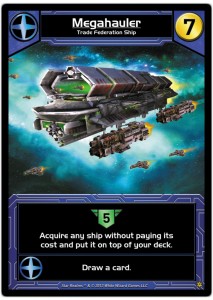
Do you remember your first impression of this card? I do. Sweet art, a great name, potential for abuse, almost-unnecessary authority gain, and above all: Interesting & Fun. Few players were able to acquire it for tabletop play, as it was released in limited quantity. First offered to Kickstarter backers, it was then featured in promotional prize packs to build support Star Realms in local game stores. When the Gambits digital expansion was released, it gave the general online audience their first opportunity to play with the big blue topper.
The initial digital expansion required the use of the Gambit cards to incorporate the new ships and bases. Strong opening Gambits, Political Maneuver and Unlikely Alliance provided powerful, resource boosted openings that had never been experienced in base set play. Some felt that this upset the balance that had been established with the original offering. Players could purchase the Megahauler or its Machine Cult Rival Counterpart, The Ark during the first and second turns, prior to even a single shuffle. This was widely viewed as Over Powered in the community. White Wizard Games later separated Gambits from the Year 1 Promos. Today you can play with either or both in the app.
An early Ark is a brutal, daunting obstacle to overcome. While there are efforts that you can make to combat this, it is an uphill battle that requires immediate recognition, a cooperating trade row, skillful execution, and dumb luck from the shuffler. We can discuss this another time.
An early Hauler is more interesting. It is NOT the auto-win some believe it to be. A deck built around topping ships does benefit from some strategy. I have occasionally been disappointed to find that the potential for abuse never materializes. And on the flipside, I have been pleased to help my opponent find the same.
If using Gambits and offered a pre-flip Megahauler, you have to take it. If not using Gambits, the soonest you could grab it is on turns 3 and 4. This discussion assumes that you have taken it during this early stage of the game. A mid or late game Hauler isn’t a bad thing, however chasing it can be costly.
UNDERSTAND AND REMEMBER THAT YOU WILL PROBABLY ONLY SEE 3-4 TOPPING OPPORTUNITIES IN AN AVERAGE GAME
Piloting a Hauler Deck
Now that you have mighty Megahauler, you will want to build a deck that has the best opportunity to harvest its potential. You have two goals: a) see the Meghahauler as often as possible, and b) help it find smart, meaningful grabs. In general a good grab is a ship that would otherwise cost you 5 or more resource. There are effective ways and ineffective ways to win with a Hauler deck. Some players will lose sight of solid Star Realms fundamentals. I want to help you avoid this. Here are some tips.
Pitfalls
1. You no longer need resource based ships. Do not make any further purchases (or Hauler grabs) dedicated to adding buy power. Quickly shed any Explorers that may have helped you acquire the Hauler. Do Not Buy any more Explorers under any circumstances.
2. Avoid temptation #1: Buying your way to a worthy freebie. The Hauler is in your hand, and there are no obvious topper targets. It will be tempting to use your resources to buy inexpensive (1 or sometimes 2 cost) ships to clear the path in the search of better options. The problem is that these purchases will dilute your deck. As a consequence, you will see your Hauler and its good grabs fewer times. Avoid all 1 cost ships (except possibly Trade Bots early). Take 2 cost ships with caution. I might even pass on a Cutter.
3. Avoid temptation #2: Topping a ship Just Because You Can. If the only topping options are smaller ships that will mostly dilute your deck, it may be better to just pass altogether. It feels wasteful after you invested 7 early resources in this ability, however the better play may just be to try cycle around to another try as quickly as possible.
What should you do instead?
(by order of importance)
1. First, trade row manipulation will be very beneficial in seeking good grabs without accumulating bad ones. Battle Pod, Blob Destroyer, Battle Screecher, and soon Spike Pod are all fantastic in Hauler decks. It is important to make a distinction here. Make your purchases and use your Row Manipulation before Hauling. This will give you the most opportunity to find the bombs.
2. Next buy scrappers. Get those starter cards out of your Hauler’s way! You want to be cycling through as few cards as possible this game.
3. Third, purchase bases. Yellow bases will supplement damage, as the Hauler neither deals nor guarantees it. Recycling Stations will help you see the Hauler more often. Blue bases will help faction your Hauler, allowing you to play your freebies on the same turn. Red bases can help you scrap without impeding the parade of bombs coming off your draw pile. Outposts in general will help lengthen the game and allow your deck to come together.
The Win
1. Finding the bombs and lifting them from the row into your opponent’s face is the most obvious path to victory. And the most fun.
2. If the shuffler did not cooperate, hopefully you have instead hoarded bases and scrap. Ride this out! A solid, scrappy ALL YOUR BASES deck often wins with or without the benefit of a Megahauler. And you are still able to look for Hauler-Haymakers off the top of the late game trade row FTW.
GG!
Stifling an Opponent’s Hauler Deck
In defending against an opponent’s Hauler, look to help push him or her into the pitfalls described above. Your goal will be to help dilute their deck with sheer quantity. You can deliberately tempt the player to settle on purchases/toppers that clog up his deck. The bigger your opponent’s deck, the better for you. If he is trying to operate through 25+ cards, regardless of it containing a Megahauler, he most likely just has A Bad Deck.
1. Stop buying resources out of the row. Tempt your opponent into doing so. If the row is full of buy-power and it’s early, maybe it’s acceptable to buy a few Explorers instead. You will be able to scrap them later in the midgame after you have some damage. Let your opponent work around the resource based ships; first in the row, and then through their shuffle.
2. Steal away the goods. Most obvious, the big ships. But less obvious:
a) Buy up all of the green trade row manipulators discussed above. For the same reasons the Hauler player wants them, but to ensure the opposite result. On this side of it, make your purchases first, and then wipe the row of anything worth taking. Make sure to leave the crap where it lies.
b) Deny access to scrappers. Again, you are trying to dilute your opponent’s deck in an extreme way. So horde that scrap even harder than normal. Make sure he drowns in a sea of Starters and bad decisions.
3. Benefit from what your opponent leaves behind. A Hauler opponent is often tunnel-visioned on big bombs. He will make the aforementioned mistakes because he is trying to capitalize on the early investment. In doing so he, may leave moderate damage in the row. Buy up as many of those 3 and 4 cost ships as possible. Try to jab your way to a flat, aggro win before your opponent finds enough spikes.
Thanks for your time, everyone. Whether you love or hate the Megahauler, or are entirely indifferent, I hope this will help you think about the card in new ways. Overpowered? Overrated? It often comes down to how it’s owner aides or impedes its impact.
By Matt Newburg (TheCutter)






 Megahaulin Blog for Star Realm Strategy