
by Scott Heise aka HomerJr
The average game of Star Realms lasts 25 turns. That means each player only gets 12 hands on average with which to reduce their opponent’s authority to zero. With so few precious turns, it is therefore very important to make the most of each and every hand. More importantly, these 12-14 hands per player are distributed among the “decks” formed by each reshuffle and each card in your deck can only be played once per shuffle. Understanding how these decks affect the pace of the game, and thus your decision making, is one of the keys to becoming an advanced player.
Let’s break down a “typical” 25-turn game, and discuss how it should affect your strategy…
(Note: “Turns” is the number of game rounds irrespective of player (odd turns are player 1, even turns are player 2); “Hands” is the number of rounds per player)
- Deck 1 (starting deck): Turns 1-4; Hands 1-2
- Deck 2: Turns 5-8, Hands 3-4
- Deck 3: Turns 9-14, Hands 5-7
- Deck 4: Turns 15-22, Hands 8-11
- Deck 5: Turn 23-26, Hands 12-13
For an average 25 turn game, this means that the game will end prior to Deck 5 being exhausted… hence the title of this article referring to “Four and a Half decks”. As roughly 60% of games end between Turns 23-28 (in my experience), the majority of games will be decided by whether you gain enough combat to reduce your opponent’s authority to zero on the first, second, or third hand of Deck 5.
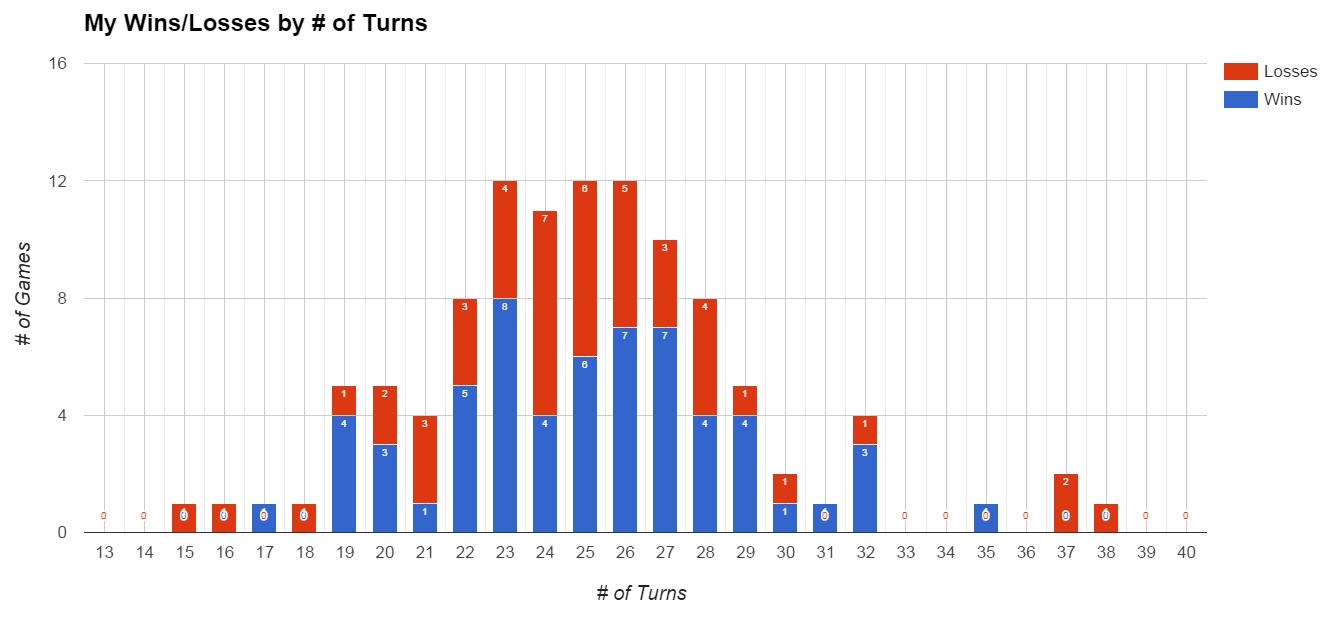
HomerJr’s Wins/Losses by Number of Turns in the recent BGG Pan-Galactic League (109 games), roughly illustrating the distribution of turns per game (note the majority of games ended at 25 +/- 2 turns)
(Obviously the specific number of turns will be affected by things like scrapping cards, how many cards you buy etc, but this is meant to be an overall introduction to the concept of “decks” and the pace of the game. I hope to go into more details about how to control and adapt to the pace of the game in the articles in this series.)
So, why are “decks” so important?
Here are some of the main ways in which understanding the “decks” affect the play of the game:
- Affects the timing of when you’ll be able to play cards you just bought. Because a newly purchased card will go into your discard pile when it is bought (ignoring “top-decking” abilities for the moment), the earliest chance you will have to draw, and thus play, the new card will be in a hand during the subsequent Deck. If you just shuffled your Deck, then this means there will be anywhere between 3 and 6 turns (nearly a quarter of the game) before you get to play that new card, whereas a card bought just before a shuffle could be drawn on the very next turn.
- Determines the number of times you get to play each card during the game. You can only play a card once per deck since each card you play is discarded after you play it (bases can be an exception to this… more on that in a sec). Thus, the number of “decks” remaining in the game the most times you will be able to play the card in the game. For example, in a “typical” 25-turn game, you will get the chance to play a card bought during Deck 1 (one of your opening buys) 3 to 4 times because there will be 4 more shuffles/decks before the end of the game. Likewise, a card bought during Deck 3 will only get played once or twice, and a card bought during Deck 4 may not get played at all before the end.
- ... and thus the cumulative value of the card over the course of the game. Here are some example of how knowing the number of decks you have left in the game can be used to evaluate the value of a card. In a for a “typical” 25-turn game:
- Your starting Scouts and Vipers will be played 4-5 times each (provided they aren’t scrapped).
- A Cutter bought during Deck 1 (one of your opening buys) will generate 12-16 authority over the course of the game.
- The Trade Bot bought during Deck 1 (one of your opening buys) will scrap 3 cards during the course of the game, reducing your overall deck size by 2 cards by Deck 5.
- A Blob Destroyer bought during Deck 2 will generate a total of 12-18 combat over the course of the game.
- If you buy a trade card (like a Trade Pod) during Deck 2, the earliest that you’ll be able to play the trade card will be Deck 3; thus, the earliest that you can draw the card that you bought with the trade from that trade card will be Deck 4.
- Gauging how many more turns/shuffles you need to defeat your opponent. Later in the game, try doing this math: add up how much combat you have in your hand and draw deck, and add that to the total amount of combat you have in your entire deck (counting the combat in your hand and draw deck again). Subtract the defense of all bases and authority gained by blue cards in your opponent’s deck. Is the result greater than the amount of authority he has? If yes, then you will likely be able to defeat him/her during your next Deck. If not, you’ll need at least two more shuffles… so you’d better find a way to get more combat or extend length of the game so that your opponent doesn’t defeat you first.
- Luck factor and bottom-decking. If a shuffle is triggered while you have cards in hand or in play, those cards will not be included in the shuffle, which means they have essentially “skipped” an entire deck and you will play that card one fewer time during the course of the game. Often the player has no control over the shuffle of his deck and which cards will be bottom-decked (random/luck), but sometimes the player will have the ability to choose when to trigger a shuffle and thus whether to bottom deck his cards in play or not. Recognizing and taking advantages of these opportunities can often be the difference in the game.
How do the “Decks” affect strategy?
Hopefully the points above have already got you thinking about how keeping track of the pace of the game (i.e., which “deck” you are in) might affect your strategy. For example, trade cards and scrap strategies are typically very slow because they take several decks to amortize their value, whereas combat has an immediate impact. Bases tend to slow down the game if your opponent is destroying them (by absorbing his combat), but can also speed up the game if your opponent lacks the ability to destroy them (because they will make your subsequent hands stronger if they stay alive for more than one turn).
Strategy vis-a-vis the pace-of-the-game is a topic for a whole ‘nother set of articles, but strategy in “typical” 25-turn game might look something like this:
- Deck 1 – “INITIALIZE”
- Opening buys will define your initial strategy, whether it be for a “slow” game (trade, scrap) vs “fast” game (combat) vs balanced (neither fast or slow)
- Prioritize trade cards and scrappers, as they will have maximum time to amortize
- Buy combat cards only if your opponent buys a base
- Deck 2 – “REINFORCE”
- Buy cards that reinforce your initial strategy, OR pivot your strategy if needed based on the trade row and your opponent’s moves
- Still okay to buy more trade cards and scrappers
- Make sure you have enough combat to destroy your opponent’s bases
- Deck 3 – “SOLIDIFY”
- Lock in on your strategy; usually too late to pivot to a new strategy
- Focus on buying powerful $6-8 cards, otherwise buy the best cards that fit with your strategy
- Focus on buying combat if you’re ahead (or want to speed up the game) or bases if you’re behind (or want to slow down the game)
- Generally too late to buy new scrappers or trade cards
- Deck 4 – “STRENGTHEN”
- Focus on buying as much combat as possible in as few cards as possible
- Otherwise, only buy cards that can fuel big combos (such as cantrips, draw a card triggers)
- Make sure you have enough total combat in your deck to defeat him during Deck 5, otherwise buy bases try and to extend the game
- Focus on buying as much combat as possible in as few cards as possible
- Deck 5 – “FINISH HIM”
- Finish off your opponent as quickly as possible by any means necessary,
But what about for games that aren’t “typical”? Many games will be shorter than average (most last at least 20 turns) and many games will be longer (rarely longer than 30). How do I know if the game will be shorter or longer? What strategies work better for long games vs short games?
Coming soon…
Pace of the Game, Part 3: Slow strategies vs Fast strategies
Pace of the Game, Part 2: Knowing How and When to speed it up and slow it down
 Megahaulin Blog for Star Realm Strategy
This is really good stuff. Well said. I think analyzing slow vs fast is really important, so I’m glad you’re going to spend an article on that. The only thing I didn’t totally agree with was your advice during Deck 1, particularly bullets 2 and 3. For bullet 2, I’d say something like, “this is the best time to buy trade/scrapping” instead of saying to prioritize them. Also I think you can buy combat cards even if your opponent doesn’t buy a base. Maybe something like, “Consider buying damage cards if you you want a fast game or if your opponent bought a base”.
LikeLike
Thanks! I think you make great points. I chose to be more authoritative with my choice of words because I think it is more common to win games with early trade/scrapping than not, but you’re certainly right that this is not always the best action to take in certain situations. Great feedback!
LikeLike
Agreed, great piece. However, I couldn’t shake the feeling that this doesn’t cover the yellow deck very much. Could be that you’ll cover that in a different piece, but one way of speeding up the game is going yellow.
Again; really good piece there!
LikeLike
Good point. I suppose I don’t see Star Empire cards as being fundamentally different than any other factions that deal damage. As a whole, they deal less pure damage than Blobs but have more cantrips (draw a card) and thus are better for deck velocity (important in the late game). Their ability to force opponent’s discards is only valuable when you can make them discard 3+, which is fairly niche so is generally not something I’d build a high-level strategy around.
Perhaps I’ll get more into this in a future article I’m planning about being colorblind when it comes to evaluating cards in the trade row. 🙂
LikeLike
Pingback: The Pace of the Game, Part 2: The Tortoise, the Hare and the Missile Bot | Star Realms Strategy!
Pingback: Betcha can’t scrap just one! | Star Realms Strategy!
Question: what is the difference you are making when referring to Turns 1-4; Hands 1-2?
Are turns and hands not the same thing?
LikeLike
The Star Realms app counts “turns” as the sum of both players hands, so playrr 1’s hands are the even numbered turns and player 2’s hands are odd. In other words, Turn 4 would be Hand 2 for player 2.
LikeLike
Great articles! A lot of people tend to ignore the subtle strategy in Star Realms, thinking that it is luck of the draw rather than calculated risk taking. However, I’d think it’s not accurate to say games end with about 4-5 decks. For instance, I’ve had a game once where my opponent managed to create a very fast Star Empire/Machine Cult deck which had only ~14-15 cards. With two recycling stations, he cycled through the full deck every turn because he had sufficient cantrips to keep the combo running. As a result, he burnt through his entire deck every turn, dealing ~20-30 damage. It was simply devastating, though I suppose I’m partly at fault for failing to stop him from acquiring the necessary cards.
LikeLike
Pingback: And Now for Something Completely Empirical: Opening Hands and Buys | Star Realms Strategy!