By Derek Thompson (aldaryn)
 For better or for worse, Star Realms is not the game it was upon release, and I don’t just mean that there are more ships and bases. The original core set was a fantastic deck-building game, but an inherent feature of its gameplay was a considerable slowness to the feedback loop. What I mean by that is, when you purchase a card, it usually takes at least a turn (if not several) for it to show up and do anything of use. The basic exception would be buying a card and then forcing a shuffle; the only other exceptions in the core set are Freighter, Central Office, and Blob Carrier, and those require some combination of ally effects and card draws to have immediate effect.
Since then, we’ve had:
- Ships that can guarantee any size ship on top (Megahauler),
- Ships and bases that easily put things straight to play or in hand (Construction Hauler, Factory World, Moonwurm, Leviathan),
- Ships and bases that can be bought straight to the hand (Colony Seed Ship, Warning Beacon, etc.),
- Heroes that can be used immediately upon purchase with no prerequisites (and are inexpensive!),
- Gambits that can guarantee cards on top (Salvage Operation, Rapid Deployment),
- Events.
For whatever reason, despite all of these similar changes to the game – the shortening of the feedback loop – Events are by far considered the most offensive. My main assumption is that this is because some of them damage you and the rest offer a benefit to your opponent, and often a better one. My goal with this article is not to deduce why Events are the least popular expansion, but instead to teach you how to play well with them. You know, just in case.
The Five Principles of Event Play
The first, most basic step to dealing with Events is doing your best to avoid getting screwed by them. The next step is playing to them instead of just surviving them. Here are my five guiding principles for playing with Events.
Principle #1: They won’t be as surprising if you know what they do.
 This may seem an obvious point, but I bet if you dislike Events – especially if you played with them a few times, hated it, and turned them off – you could not recite what the 12 cards do. In fact, it’s hard for me to remember them all sometimes (I tend to forget Galactic Summit). My conversations with many different Star Realms players have convinced me that the number one reason people dislike Events is because they feel like they happen “out of nowhere,” or “they didn’t see it coming.” While when they appear is random, what they do isn’t at all. I don’t need to write them down here as you can simply go to the Star Realms Card Gallery, but I do want to help you think more broadly about what the impact of an Event, in general, will be.
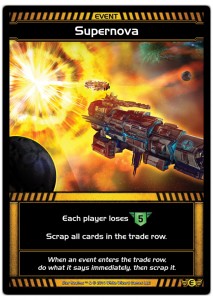
- 25% (3 out of 12) Events actually do damage to the players, while 1 out of 12 (8.3%) of the cards heal both players. These are the four 1-of cards; the Events you are far less likely to have. Of course, depending on the format, Supernova (8.3%) can be quite likely to flip another Event.
- Of the Big Eight, 4 of them (33% of the set) draw you cards immediately; while 6 of them (50%) are guaranteed draws for your opponent on their turn. (Those are the two big numbers, people.) Of course, the 2 Trade Missions (17%) do give you an immediate benefit.
- The usefulness of the 2 Comets (17%) depends entirely on whether you have a starter-heavy discard pile, but your opponent can always scrap from hand while you may not be able to.
Principle #2: The later in your turn it is, the worse Events are for you.
- This is not a hard-and-fast rule, but it’s a good rule of thumb. What good is a Quasar that draws you two Scouts when you’re out of trade? If you’d had at the start of the turn, you could have bought Command Ship instead of Frontier Station.
- Both Comets and Black Hole (25%) are awful for you when you have nothing to give them. For this reason, hold back two starters unless you absolutely need them for a purchase. NEVER play Vipers until you are done purchasing. NEVER HIT PLAY ALL. (Do as I say, not as I do.)
- If you are intending to buy more than one card this turn, buy the cheapest one first. Yes, there is a small chance that Supernova might consume the big card you wanted to buy, there’s one of those, and 6 Events that will help you buy stuff on this turn. If you’re going to have more trade this turn, when do you want to know that? When you have the most trade left to still work with.
- Likewise, think about Events when deciding to use Battle Pod / Battle Screecher / Swarmer / Ravager / etc. It’s often asked whether you should scrap a trade row card before buying or after. It entirely depends on whether there are good cards in the row for you, and whether you have trade, but now also depends on Events. If you can almost buy a big card, you might consider scrapping something else from the row at the beginning, in hopes of getting a boost from an Event. On the other hand, Events may give you a good reason to not use the ability at all (see next Principle).
- While I think you want Events to happen earlier in your turn, be careful at the end of a deck cycle. If you only have 0-2 cards left in your deck, Warp Jump / Quasar could flip your deck. So, if you are going to scrap from discard, do that before you buy or scrap from the trade row.
Principle #3: All Events (except Galactic Summit) accelerate the game state.
- In general, there are several things in Star Realms that show a sign of progress in the game. Decks with more purchases / fewer starters and lower life totals are the two big ones. After all, those are the two big goals: have an awesome deck and kill your opponent. All Events (okay, except Galactic Summit) push the game faster towards its end, by allowing for bigger purchases, damaging players, scrapping cards out, causing another deck cycle, and so on. Whether you want this to happen is another matter.
- Who’s the Beatdown? One of the most important Magic: the Gathering articles ever written was “Who’s the Beatdown?” by Mike Flores, almost 20 years ago. The main lesson applies even more to Star Realms, which is this: which deck are you? Are you the offensive player or the defensive player? Even in mirror matches, at any point time, one person is ahead in the aggressive role and one player isn’t. The same deck should be played differently depending on which role you are currently in. Your purchases should reflect this, and so should your interactions with Events. If you are the aggressive player, trying to kill your opponent as fast as possible, you want more Events to happen. They keep your opponent from having more time to take advantage of their slower moves, such as scrapping and base-buying. If you are the defensive player, you want fewer Events to happen, so be careful about your scrapping from the row and your timing of purchases. In particular, the more scrapped out you are, the less useful Events are for you.
- Gambits also accelerate the game. Keep this in mind when playing with both.
- Bombs happen earlier in the game and can be more game-defining. Players can get a turn 1 Ark to the top of the deck! This is especially true when playing with both Events and Gambits. Oftentimes, a race for a 7 or 8 cost card in a traditional game can be worthless, spending forever buying Explorers when your opponent Pods it away and beats you down in the meantime. With Events, it doesn’t take much to get 8 trade. This makes trade row control all the more important. Many of the times I’ve managed to beat the Ark, it was by using aggressive trade row scrapping to trigger Events and accelerate my play while not accelerating my opponent’s, who had very few cards to draw with Quasar / Warp Jump / Trade Mission.
Principle #4: Know your tips and tricks.
 These don’t fall into any of my other principles, but are still important points to make about Events.
- In general, your opponent gets more out of an Event than you, since they get it at the start of their turn. The big exception to this is your last, winning, turn. If you get the kill shot, then they never get the benefit of those last Events. This cannot be understated. If you’re on death’s door but think you could win with just a little help, it is time to dig, dig, dig! (The other exception is Events that show up in the initial trade row, on the start of turn 1. However, since your opponent has a 5-card hand, they still probably get more out of it, though you get first crack at the trade row.)
- Certain cards have a very different valuation with Events. The big ones, of course, are trade row scrappers, Battle Screecher in particular. The other broad valuation change is bombs versus weak and midrange cards. It’s so much easier to get a bomb that they are much more viable, and weaker cards might be less worth the clutter in your deck or the danger in flipping the trade row. The Ark is even more of a game-warper than usual, because it’s accessible so much earlier. However, once a player has the Ark, subsequent Events work against the player with The Ark, by minimizing the advantage of a seriously scrapped deck.
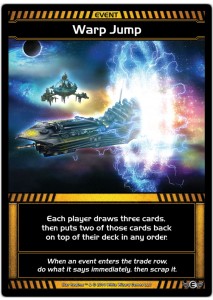
- If you only have 0-2 cards in deck+discard, Warp Jump will not give you anything.
- Supernova can kill someone if it happens before you apply your damage. If you apply your damage and knock them to 5, and then Supernova happens, they will only go down to 1. This is always what happens with Black Hole and Bombardment, because damage is not applied until the opponent makes the choice on their turn, even if there is no choice to make. (And this is only for digital; Events can kill players and even cause draws in the paper game.)
- While it’s hard to see the psychology of a match in a digital game versus paper, it’s definitely there. Events can often put your opponent on tilt – or put you on tilt. Being prepared for them – even playing them to your advantage – makes a huge difference.
Principle #5: Practice.
I know people are very proud and protective of their win percentages online, but I’ve started to convince myself that that’s rubbish. The way you improve at any game is to try new things, lose, and try again. To play well with Events, you need to practice. In particular, you need to think of Events as part of a broader class of “mid-turn shenanigans” (see initial paragraphs) that can change things up. I also believe Battle Screecher and The Ark are important parts of learning to play with Events. I recommend playing W1HE with one or both Gambit sets attached – basically only sets that mess with you in this way. The games will feel very different, but you’ll quickly learn how to use caution after getting burned several times. Once you’ve learned to take those precautions, you’ll still use them in Bigdeck, when Events only trigger a fraction of the time. If you are that worried about your win percentage, then practice this against the Hard AI.
Summary
When Events first came out, I was pretty frustrated with them, to be honest. But over time I’ve not only enjoyed playing with them, I’ve taken them to be a legitimate advantage. Hopefully these pointers can give you the same edge. If you take nothing else away, just remember this: before moving a card off the trade row, ask yourself “What possible Events could flip, and am I prepared for them?”
 Megahaulin Blog for Star Realm Strategy
One of the best articles on Star Realms I have read. Well done. It was quite eventful.
LikeLike
Thanks!
LikeLike
Well done, Derek!
LikeLike
Good article!
I’ve never understood the hate for Events, they can be fun if you wield them properly. The only reason I stopped playing with Events after a while was Supernova – it destroys the whole trade row I was basing my strategy on, and more often than not flips more Events, allowing anarchy to reign.
LikeLike
You can just leave it out, or replace it with a promo Event if you want 12 (e.g., Rescue Run or one of the Frontiers promo pack Events)
LikeLike
Great Stuff! Very Informative.
LikeLike
Pingback: Frontiers Events! | Star Realms Strategy!